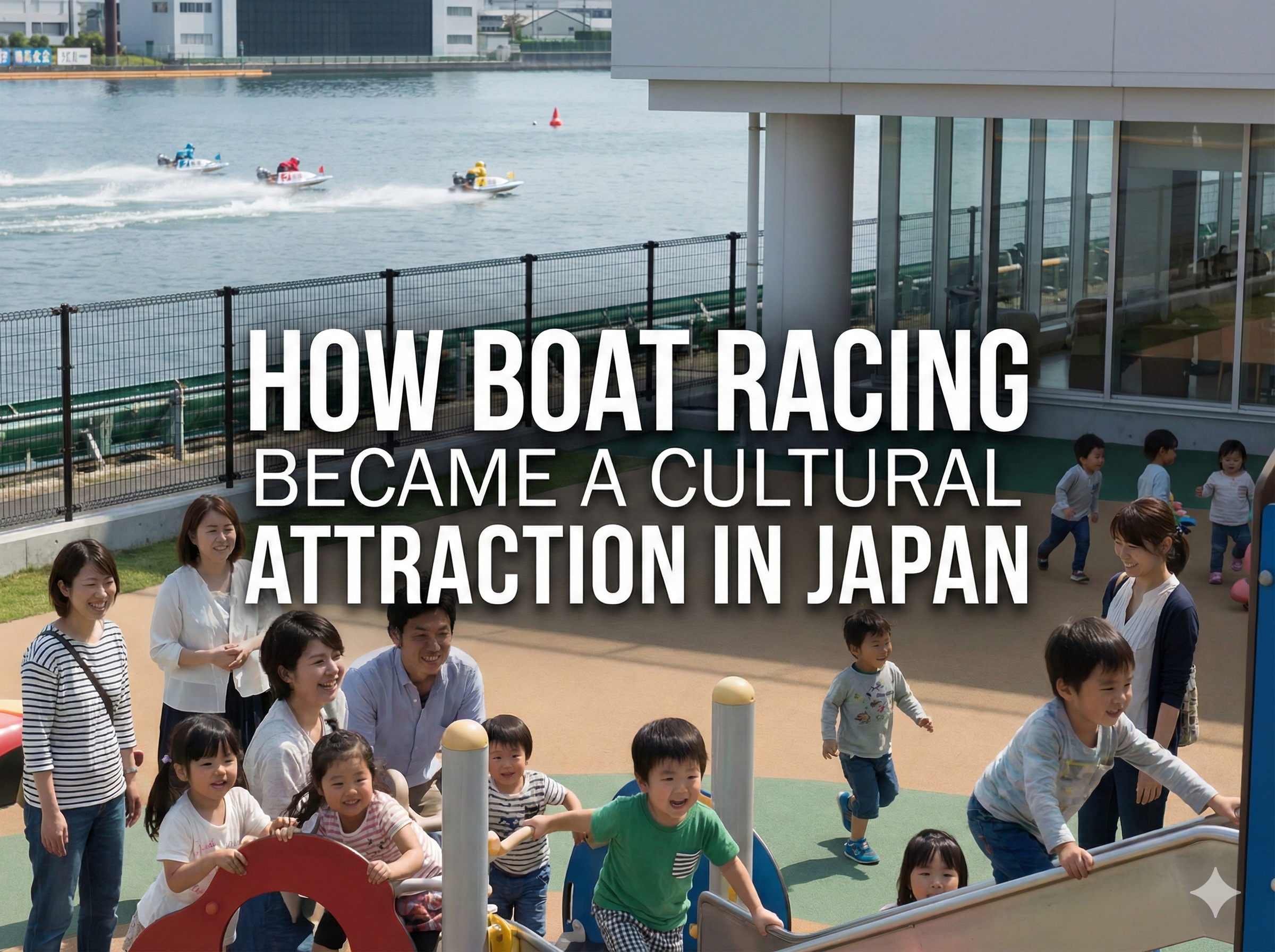
Boat racing was once known as "kyotei" and was recognized as a gambling industry centered on adult men. However, since the brand name change in 2010, it has undergone dramatic transformation. Today, it functions as an entertainment facility that families and tourists can enjoy, contributing to the reconstruction of local communities and creating value as a tourism resource. This article explains how boat racing has evolved from a postwar public gambling system to a modern cultural content from a cultural perspective.
Table of Contents
1
From Postwar Gambling to Entertainment
Boat racing began as a public competition in 1952, shortly after the war. For a long time, it was known as "kyotei" and was recognized as a gambling industry centered on adult men. However, in 2010, the industry association, the National Motorboat Racing Association Federation (including related organizations such as the current General Incorporated Foundation BOATRACE Promotion Association), unified the name from "kyotei" to "BOAT RACE" and introduced a new corporate identity (CI) to refresh the brand image.
This change was not merely a superficial name change, but a strategic turning point that expanded the target audience from traditional fans to younger generations, women, and families. The core of this strategy is the "parkification (multi-facility development)" of race venues. By transforming race venues from closed gambling spaces into open "parks" that local residents can use daily, this initiative lowers psychological barriers to entry while making contributions to local communities visible.
Today's boat racing business goes beyond simply securing sales of betting tickets (boat tickets), performing multifaceted functions such as reconstructing local communities, supporting child-rearing, providing disaster prevention bases, and creating value as tourism resources. In fiscal year 2023 (Reiwa 5), total sales at 24 race venues nationwide reached 2,422,001,244,400 yen, recording 100.3% growth compared to the previous year. What supports this huge market is the overwhelming success of digital transformation. Approximately 78.5% of sales (about 1.9 trillion yen) are generated through telephone betting (including internet betting), and this change in revenue structure is the source of capital that transforms race venues from "revenue collection devices" into "local community contribution facilities."
2
Changing Public Image
Boat racing's image improvement was not achieved through name changes alone. Through actual facility reforms, it has evolved into an essential "public garden" for local communities.
At race venues across the country, sophisticated spatial design based on urban planning, regional disaster prevention, and educational theory is being implemented. For example, "Community Park Gruun Omura" in Omura City, Nagasaki Prefecture, opened in November 2022 and dramatically enhanced its function as a hub for local communities. The facility consists of four areas: Park Center, Bouldering Center, Skateboard Park, and Outdoor Playground Area, each with clear targets and functions.
"UZU PARK" in Naruto City, Tokushima Prefecture, is an advanced example that integrates sports promotion and regional disaster prevention. The facility introduced the concept of "Phase Free" and obtained Phase Free certification (ID: PF1222038). Phase Free is a design philosophy that coexists the value of normal times (always) and emergency times (what if), designed so that spaces where people enjoy skateboarding and basketball in daily life can function as evacuation bases and rescue activity spaces during disasters.
The "Mooovi" brand developed at venues such as Boat Race Hamanako in Shizuoka Prefecture and Shimonoseki in Yamaguchi Prefecture is a collaborative project with Bornelund Co., Ltd., which imports and sells educational toys and playground equipment. In response to the issue of children's "lack of play" in modern society, it aims to utilize unused spaces within boat race venues to provide "safe and stimulating playgrounds." Specialized staff called "play leaders" are stationed there, not to supervise or instruct, but to act as catalysts that draw out children's desire to "try things" and develop play.
These facilities are provided free of charge year-round (except during some events), regardless of whether races are being held, demonstrating that local governments are returning boat racing business revenues as direct citizen services.
3
Collaboration with Tourism
Boat racing can serve as attractive content for foreign tourists (inbound) as a unique Japanese cultural experience. Race venues across the country are beginning to function as access points to tourist destinations.
Many race venues have access from airports and major stations. For example, Boat Race Naruto is about 17 minutes by car from Tokushima Awa Odori Airport and is directly connected by express bus from the Kansai area, making it easy to incorporate into tourist routes. The admission system requires no advance ticket reservations, and the admission fee is only 100 yen (coin-operated gate). On off-track betting days (days when races from other venues are watched on monitors), admission is often free, and many race venues operate free shuttle buses, complementing their role as transportation (secondary transportation) for tourists.
For foreign tourists, English notation has been introduced on mark cards and ticket machines, and international standard terms such as "Trifecta" are used, making intuitive participation possible. Betting types include, in addition to win and place bets, Trifecta (first, second, and third place in order), Exacta (first and second place in order), Trio (three boats finishing in the top three regardless of order), and Quinella Place (two boats finishing in the top three), making it easy for foreign tourists to understand.
Connections to historical and cultural contexts are also important tourism resources. The "Nagasaki Peron Championships" held in Nagasaki Prefecture is a traditional event with 360 years of history, which began as a ritual to appease the sea god's anger. Thirty people board a 14-meter wooden boat and row 1,150 meters to the rhythm of drums and gongs. By contrasting this "human-powered boat race" with the modern "engine-powered boat race (Omura)," tourism that experiences the depths of Japan's maritime culture becomes possible. Programs such as experience boarding are available for foreign tourists, and it is positioned as a symbolic event of "Exotic City Nagasaki."
4
Family-Friendly Facilities
The parkification of boat race venues has realized facilities that families can use with peace of mind. At race venues across the country, playground equipment designed to draw out physical movements appropriate for children's developmental stages has been installed.
The outdoor playground area of "Gruun Omura" features equipment manufactured by Bornelund. The Double Mega Deck is for ages 4-12 and is a symbol tower that develops whole-body strength and balance through climbing movements on nets and walls. The Tipi Carousel is for ages 4-15 and is a rotating playground equipment that uses gravity, encouraging communication between children riding inside and those pushing from outside. The Toddler Castle is for ages 1-3 and is designed so that infants who have just started walking can safely repeat stair climbing and sliding movements.
A characteristic design feature of Mooovi Hamanako is the structure that allows the racing water surface to be seen from the playground. This allows children to experience the power of boats racing with roaring sounds during breaks in play. This spatial design is intended to incorporate boat racing as a water sport into children's primary experiences, rather than hiding it as "gambling."
For use of the Park Center and Bouldering Center, strict management is conducted through an external reservation system (Reserva). In particular, the Park Center prohibits profit-oriented use and functions purely as a place for local circle activities and learning. Regular events such as "bouldering experience sessions," "accessory workshops," and illustration exhibitions by picture book authors position the facilities not just as "boxes" but as hubs for cultural dissemination through soft programs.
5
Future of Boat Racing as Culture
Today's boat racing business has completely broken away from the narrow framework of the former "gambling industry" and has evolved into an essential "public garden" for local communities. Diverse parkification strategies such as "multi-generational exchange" at Gruun Omura, "disaster prevention functions" at UZU PARK, and "child development support" at Mooovi demonstrate that boat racing businesses provide concrete solutions to each region's challenges. These go beyond mere CSR (Corporate Social Responsibility) activities and function as CSV (Creating Shared Value) strategies for business sustainability.
As a future outlook, full-scale capture of inbound demand is expected. There is room to package night races and VIP seat viewing experiences as nightlife content for foreign visitors to Japan, utilizing English support and good access. The fusion of digital and real is also an important issue. With 80% of sales now digitalized, the value of real race venues is concentrated in "experience." Whether children who play at park facilities will become fans of the sport in the future, or become involved in the industry as racers or mechanics, is key to long-term sustainability.
Further commitment to social issues is also expected. In an aging Japan, promoting health for the elderly (such as walking in parks) and strengthening community functions as countermeasures against loneliness are important. A portion of boat racing revenues is delivered to "The Nippon Foundation" based on law and allocated to a wide range of social contribution activities both domestically and internationally. Annual grants of approximately 60 billion yen are distributed across four major fields: ocean environment conservation, disaster recovery support, cultural and artistic activities, and international cooperation, making this a unique system globally that channels public competition revenues back to social good.
BOAT RACE JAPAN will continue to expand its role as a massive philanthropy engine that quietly but powerfully supports the foundation of local communities, while also being a roaring water combat sport.
6
Frequently Asked Questions
At many race venues, the admission fee is 100 yen (coin-operated gate). On off-track betting days, admission is often free, and advance ticket reservations are not required.
Yes. Parkification is progressing at race venues across the country, with free playground areas and sports facilities available. Playground equipment appropriate for children's developmental stages is installed, so families can use the facilities with peace of mind.
Yes. English notation has been introduced on mark cards and ticket machines, and international standard terms such as "Trifecta" are used, making intuitive participation possible. Additionally, many race venues operate free shuttle buses, and access is well-developed.
Yes. Many park facilities are provided free of charge year-round (except during some events), regardless of whether races are being held. However, some facilities such as bouldering centers may require reservations.
Boat racing revenues are transferred to the general accounts of the hosting local governments and serve as sources of funds for public works. Additionally, based on law, they are delivered to "The Nippon Foundation" and allocated to social contribution activities such as ocean environment conservation, disaster recovery support, cultural and artistic activities, and international cooperation.
References
- Hatena Bookmark
- BOAT RACE Promotion Association
- Gruun Omura
- Kyushu Travel Network
- PHASE FREE
- UZU PARK
- Bornelund Co., Ltd.
- Mooovi Hamanako
- Mooovi Shimonoseki
- BOAT RACE Official Website
- Karatsu City
- The Nippon Foundation
- CANPAN FIELDS
- Japan Motorboat Racers Association
- Japan Guide
- BOAT RACE TODA
- GOOD LUCK TRIP