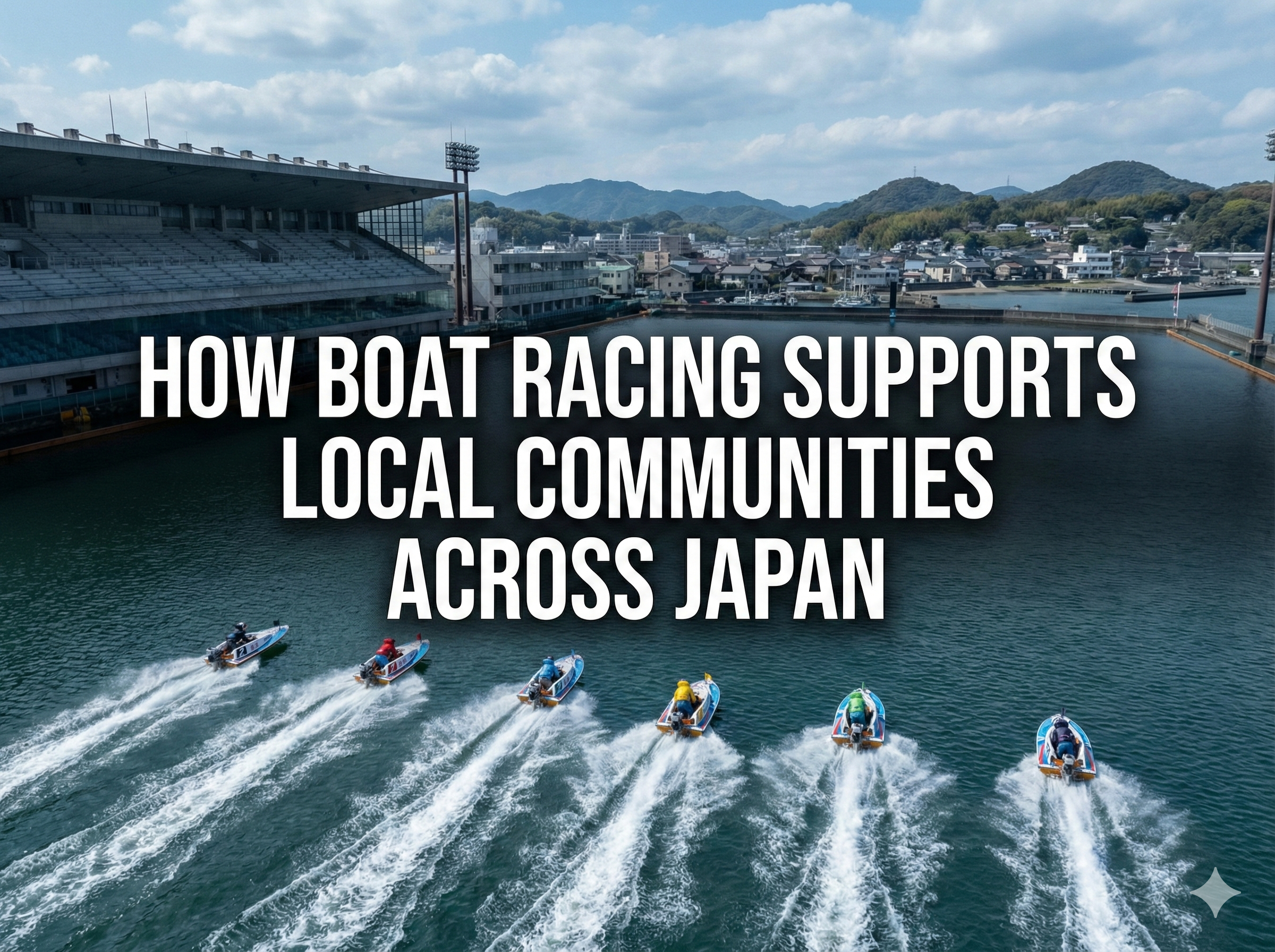
Boat racing goes beyond mere entertainment and gambling, serving as an important entity that supports the finances of local governments in Japan, creates employment in regions, and provides funding for social welfare projects. Since the enactment of the Motorboat Racing Act in 1952, this industry has played a role in post-war reconstruction and has now established itself as a "water combat sport" boasting annual sales in the trillions of yen. This article explains how boat racing contributes to local economies and communities, using specific examples.
1
Local Governments and Boat Racing
Boat racing events are held under the "Motorboat Racing Act" and are supervised by the Ministry of Land, Infrastructure, Transport and Tourism (Maritime Bureau). Under this legal framework, only local governments (cities, towns, villages, prefectures) or partial administrative associations can become organizers (operators). This ensures that profits are directly linked to public purposes of contributing to local finances, rather than private interests.
The boat racing industry is structured as a "three-tier system" operated through collaboration among multiple organizations under strict legal frameworks. This differs from many professional sports operated by private companies and stems from a system design that prioritizes public interest. The practical aspects of competitions are managed by the "Japan Motorboat Racing Association (JMRA)," which handles race judgments, strict inspections of boats and motors used, and license management for approximately 1,600 racers and judges.
2
Revenue and Public Projects
The most distinctive feature of boat racing's revenue structure is that approximately 2.6% of sales are allocated to the "Nippon Foundation," a public interest incorporated foundation, and used for social contribution activities both domestically and internationally. The Nippon Foundation uses boat racing sales as its primary funding source and provides flexible grants for social issues that are not adequately addressed by administrative support.
In the 2024 fiscal year's grant programs, two pillars of support have been established: maritime and ship-related projects (ocean research, maritime and fisheries human resource development, marine environment conservation, maritime safety) and social welfare, education, and culture (support for children, people with disabilities, and the elderly, disaster recovery, local community revitalization). Grant applications undergo strict review, and eligible expenses are subdivided into personnel costs, travel expenses, and various fees, requiring transparency in usage. This system creates a circular model where funds invested by fans are eventually returned as benefits to society as a whole.
As a specific example of a local government, "Boat Race Naruto" in Naruto City, Tokushima Prefecture, has provided over 90 billion yen in transfers to Naruto City's general account since its opening in 1953. This has served as funding for public infrastructure such as civic halls, schools, and roads, supporting citizens' lives for over half a century.
The Osaka Prefecture Urban Boat Racing Enterprise Group, which operates Suminoe, known as the "Mecca of Boat Racing," publicizes the use of revenue funds in extremely specific detail. It clearly states that funds are allocated to specific social issue solutions such as child poverty countermeasures, support for children with rare diseases, support for people with disabilities, and Hansen's disease eradication activities, working to gain social understanding (social license) for gambling revenue.
3
Jobs and Skills
Race venues are not just competition facilities but large-scale workplaces. As of fiscal year 2009, Boat Race Naruto employed 231 workers, contributing to regional employment stability.
The boat racing industry is supported by the high expertise of racers and the technicians who support them. To become a professional boat racer, one must endure one year of rigorous training at the "Boat Racer Training School (Yamato School)" in Yanagawa City, Fukuoka Prefecture, and pass a national examination. Training fees (tuition, dormitory fees, meal costs, etc.) are currently free, creating an environment where talented young people can challenge themselves regardless of their economic background. The average annual income reaches approximately 19 million yen, with top earners making hundreds of millions, making clear success rewards a motivation for harsh weight loss and training.
Mechanics who support race safety work behind the scenes. Under the Motorboat Racing Act, first-class and second-class mechanic qualifications exist. In boats racing across water at speeds approaching 80 km/h, a single loose screw can lead to serious accidents or, in the worst case, fatal accidents, requiring mechanics to have extremely high responsibility and technical skills. After obtaining a second-class mechanic qualification, one must have at least three years of practical experience before becoming eligible to take the first-class examination, making it a career path that values experience.
4
Events and Festivals
Efforts to showcase races themselves have become established. At the "SG Grand Prix," the premier race held at the end of the year, not only is there a battle for a 100 million yen championship prize, but popular entertainers (e.g., Suzuyo Yamanouchi) hold talk shows and original goods are distributed, with festivalization progressing.
Night races with lighting equipment are increasing to attract office workers after work and evening tourists. The lighting reflecting on the water surface and boat wakes create high visual appeal, also generating demand as date spots.
Boat racing-related organizations and racer associations regularly conduct beach cleanups. In a 2024 example, 20 teams participated and collected over 360 kg of beach debris, including plastic bottles labeled in Chinese and Korean. This activity incorporates a "competition format" where participants compete in the amount and quality of garbage collected, enhancing participants' motivation. Similarly, Boat Race Kojima reported collecting 300 kg of garbage.
5
Why This Matters to Visitors
Boat racing functions as an important entity supporting local economies and cultures, not just a tourist spot. When visiting race venues, understanding the regional contribution mechanisms behind them will provide deeper insight.
Boat Race Marugame donated 10 million yen to the "Sanuki Seto Ohashi Wide-Area Tourism Council" as regional economic revitalization support. This funding was used for inbound promotions featuring famous overseas influencers, resulting in achievements where boat racing revenue directly contributed to attracting tourists to the region, with over 4 million views on SNS.
Boat Race Heiwajima (Tokyo) operates free shuttle buses taking advantage of access from Haneda Airport and the city center. It combines the ease of enjoying races with a 100 yen admission fee and comfort through reserved seats, proposing itself as part of a "Tokyo itinerary."
Boat Race Suminoe (Osaka) has implemented a measure where admission is free by showing a QR code in cooperation with the "Osaka Amazing Pass." It aims to expand recognition as a tourist spot alongside Osaka Castle and Dotonbori.
Boat Race Fukuoka leverages its strength as an urban race venue located in Tenjin, a downtown area, targeting tourists from Asian countries. In addition to general seats, it has facilities such as "ROKU" for group use and VIP areas like "Royal Seats," aiming to attract affluent customers.