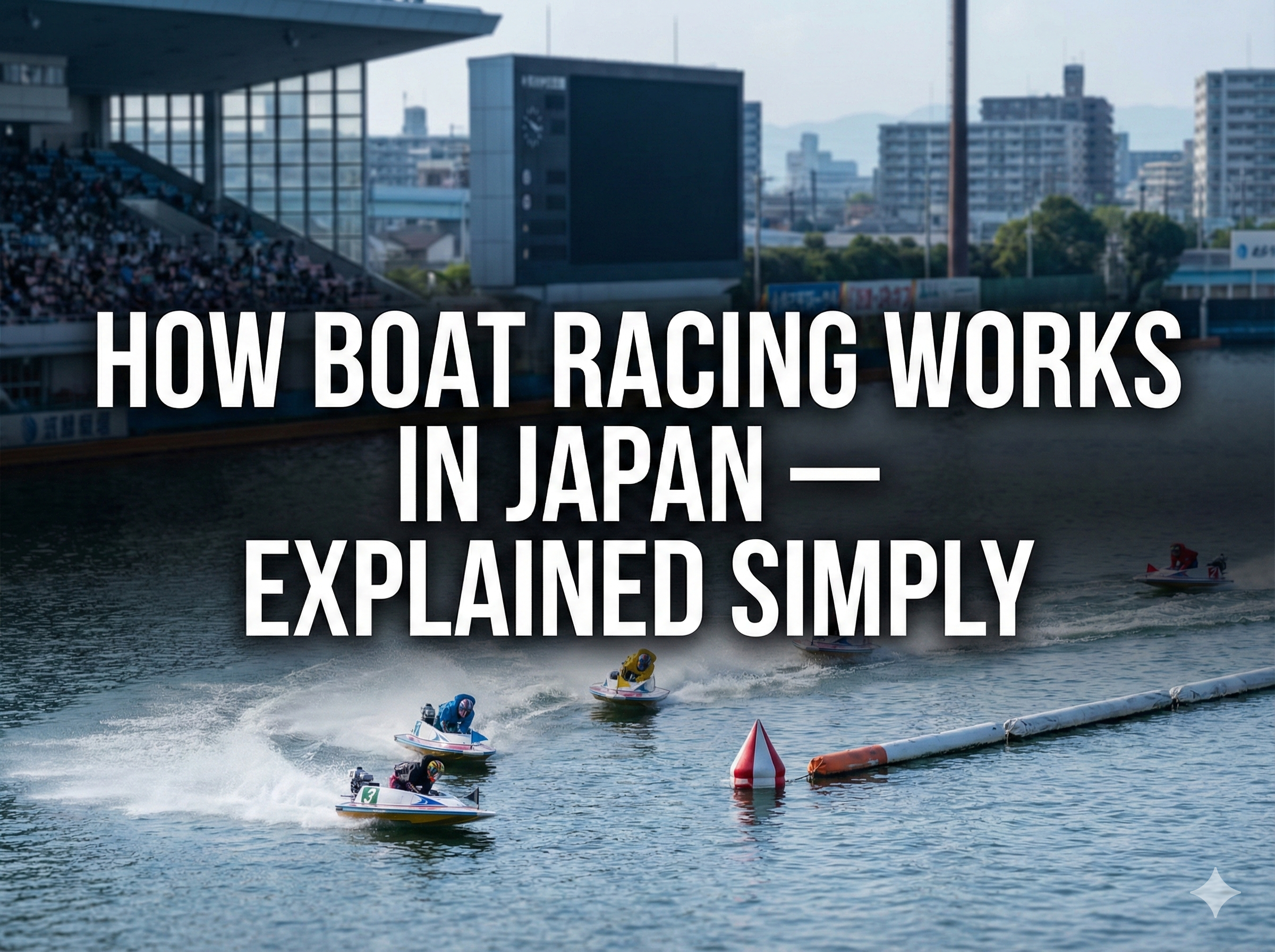
Hello, foreign travelers visiting Japan. This article explains the basic structure and flow of boat racing (formerly known as kyotei) in Japan as simply as possible. This article summarizes the information that beginners want to know about how boat racing proceeds, from start to finish. Even if the rules seem complicated, understanding the basic flow will make it more enjoyable. Please use this article to experience the world of boat racing.
Table of Contents
1
Basic Idea of a Boat Race
Boat racing is a public competition in Japan where six hydroplanes (motorboats) compete for position by completing three laps (1,800 meters total) around a 600-meter water course. The most distinctive feature of boat racing is its unique rule called the "flying start system." The start line is measured in 0.01-second units, and the boat that passes the start line earliest has an advantage.
Races are conducted using a "one-make" system where all boats use the same specification of motor and boat. Currently, all racecourses use the "Yamato 331" motor. This is a water-cooled 2-stroke 2-cylinder engine that produces a maximum output of 31ps (22.8kW). Since all racers use the same specification of motor and boat provided by the organizers, there is no advantage or disadvantage based on equipment, and the outcome depends on the racer's skill and strategy.
To ensure fairness in races, the motors used by each boat are determined by lottery before the race. This prevents any particular boat from always having an advantage. In addition, start judgments are made by electronic equipment, and measurements in 0.01-second units eliminate errors from human visual observation.
2
Race Day Schedule
On a boat racing day, typically 12 races are held in one day. Races start in the morning and continue into the afternoon. For night races, races are also held in the evening.
The flow of a race day is roughly as follows. First, before each race, racer introductions and motor lotteries are conducted. Then, racers board their boats and head to the course. Before the race begins, racers line up at the start line and prepare for the start.
When the race begins, six boats pass the start line and complete three laps around the 600-meter course. During the race, the position and information of each boat are displayed on large screens, and live commentary explains the race's progress. When the race ends, the positions are finalized, and those who placed bets (purchased tickets) receive payouts if their bets were correct.
Racecourses have betting counters, restaurants, shops, and other facilities, so you can enjoy yourself all day. Even first-time visitors can feel comfortable visiting, as staff will guide you carefully.
3
From Start to Finish
A boat race proceeds as follows. First, six hydroplanes line up at the start line. The start is called the "flying start system" and is measured in 0.01-second units. The boat that passes the start line earliest has an advantage, but if the start is too early, it becomes a "flying start" and is disqualified.
In the flying start system, the timing when each boat passes the start line is measured in 0.01-second units. If the timing of passing the start line is too early (usually earlier than 0.00 seconds), it is judged as a flying start, and that boat is disqualified. If a flying start occurs, all tickets related to that boat are fully refunded.
The race consists of three laps (1,800 meters total) around a 600-meter course. Turn marks (rotating markers) are placed on the course, and each boat must go around these marks in a counterclockwise direction. If a boat does not properly go around a turn mark, it is also disqualified.
During the race, each boat runs at high speed, gliding across the water surface. The characteristic of hydroplanes is that they run by lifting off the water surface, allowing them to run at very high speeds. The outcome of the race is determined by the order in which boats reach the finish line.
Author's
Comment
4
Lanes, Boats, and Turns
A boat racing course is a 600-meter water course per lap. Turn marks (rotating markers) are placed on the course, and each boat must go around these marks in a counterclockwise direction. Turn marks are placed at the four corners of the course, and each boat must properly go around these marks.
The course has six lanes, from lane 1 to lane 6. Lane 1 is the innermost lane and has the shortest distance. Lane 6 is the outermost lane and has the longest distance. Which lane a boat runs in is determined by the starting order. Generally, lane 1 (inside course) is considered advantageous because the distance is shorter, but outer lanes (outside course) may use a strategy of utilizing the approach distance to pass at maximum speed.
All boats use the same specification of hydroplane. Hydroplanes can run at very high speeds because they run by lifting off the water surface. The speed of boats varies depending on various factors such as motor output, water surface conditions, and wind effects.
How boats go around turn marks greatly affects the outcome of the race. If a boat does not properly go around a turn mark, it is disqualified. Also, if the way a boat goes around a turn mark is poor, its speed may drop and its position may fall. Racers place great importance on how they go around turn marks, and advanced piloting skills are required.
Author's
Comment
5
How Winners Are Decided
The outcome of a boat race is determined by the order in which boats reach the finish line. Six boats complete three laps (1,800 meters total) around a 600-meter course, and the boat that reaches the finish line first is the winner. Second and third place are also determined in the same way, by the order in which boats reach the finish line.
If rule violations such as flying starts or improper turn mark navigation occur during the race, that boat is disqualified. Disqualified boats are excluded from the rankings, and all tickets related to that boat are fully refunded.
Betting (purchasing tickets) has multiple methods, such as "sanrentan" (predicting the order of 1st, 2nd, and 3rd place) or "nirenfuku" (predicting 1st and 2nd place). If your bet is correct, you receive a payout according to the amount you bet. The payout amount varies depending on the betting method and the number of people who made correct predictions.
Race results are displayed on large screens and announced in live commentary. Those who placed bets can check the results and receive payouts if their bets were correct.
6
What Beginners Should Focus On
For those watching boat racing for the first time, knowing what to focus on is an important point. First, please pay attention to the moment of the start. In the flying start system, there is tension in competing for 0.01 seconds, and since starting too early results in disqualification, racers time their starts very carefully.
Next, please pay attention to how boats go around turn marks. How boats go around turn marks greatly affects the outcome of the race. Racers place great importance on how they go around turn marks, and advanced piloting skills are required. If the way a boat goes around a turn mark is poor, its speed may drop and its position may fall.
Also, please pay attention to the positional relationships between boats. During the race, the positional relationships between boats change moment by moment. The position of each boat is displayed on large screens, so watching while looking at them will make it more enjoyable. In particular, paying attention to how boats go around turn marks and differences in course selection will make the race's progress easier to understand.
Finally, please pay attention to the live commentary. Live commentary explains the race's progress in an easy-to-understand way, so even beginners can easily understand the flow of the race.
Author's
Comment
7
Frequently Asked Questions
One race takes approximately 1 minute and 50 seconds from start to finish. However, including preparation before the start and finalization of results, one race takes approximately 5 minutes.
The flying start system is a method that measures the timing when each boat passes the start line in 0.01-second units. The boat that passes the start line earliest has an advantage, but if the start is too early, it becomes a "flying start" and is disqualified.
Turn marks are rotating markers placed at the four corners of the course. Each boat must go around these marks in a counterclockwise direction. If a boat does not properly go around a turn mark, it is disqualified.
A boat racing course is 600 meters per lap. The race consists of three laps (1,800 meters total) around this course.
The motor lottery is a system that determines the motors used by each boat by lottery before the race. This prevents any particular boat from always having an advantage.
References
- ボートレース
- Miyajima Kyotei Freaks(宮島競艇フリークス)
- BOAT RACE オフィシャルウェブサイト
- BOAT RACE – Get a splash on the action!
- 公益社団法人 日本 ...
- FOR ENGLISH | BOAT RACE OFFICIAL WEB SITE
- About Boat Race | BOAT RACE – Get a splash on the action!
- LEVEL.2 海水プールは干潮ならまくり。満潮ならイン有利! | BOAT RACE オフィシャルウェブサイト
- 競艇の風の影響は?向かい風、追い風、横風では何コースが有利?
- Boat race Heiwajima | [Tokyo/Ota Tourism Association official website] Travel to Ota, the gateway to Tokyo
- The thrill of Japanese Boat Racing - Japan Guide
- Plan Your Visit | BOAT RACE - Get a splash on the action!
- A beginner's guide to Boat Race in Japan