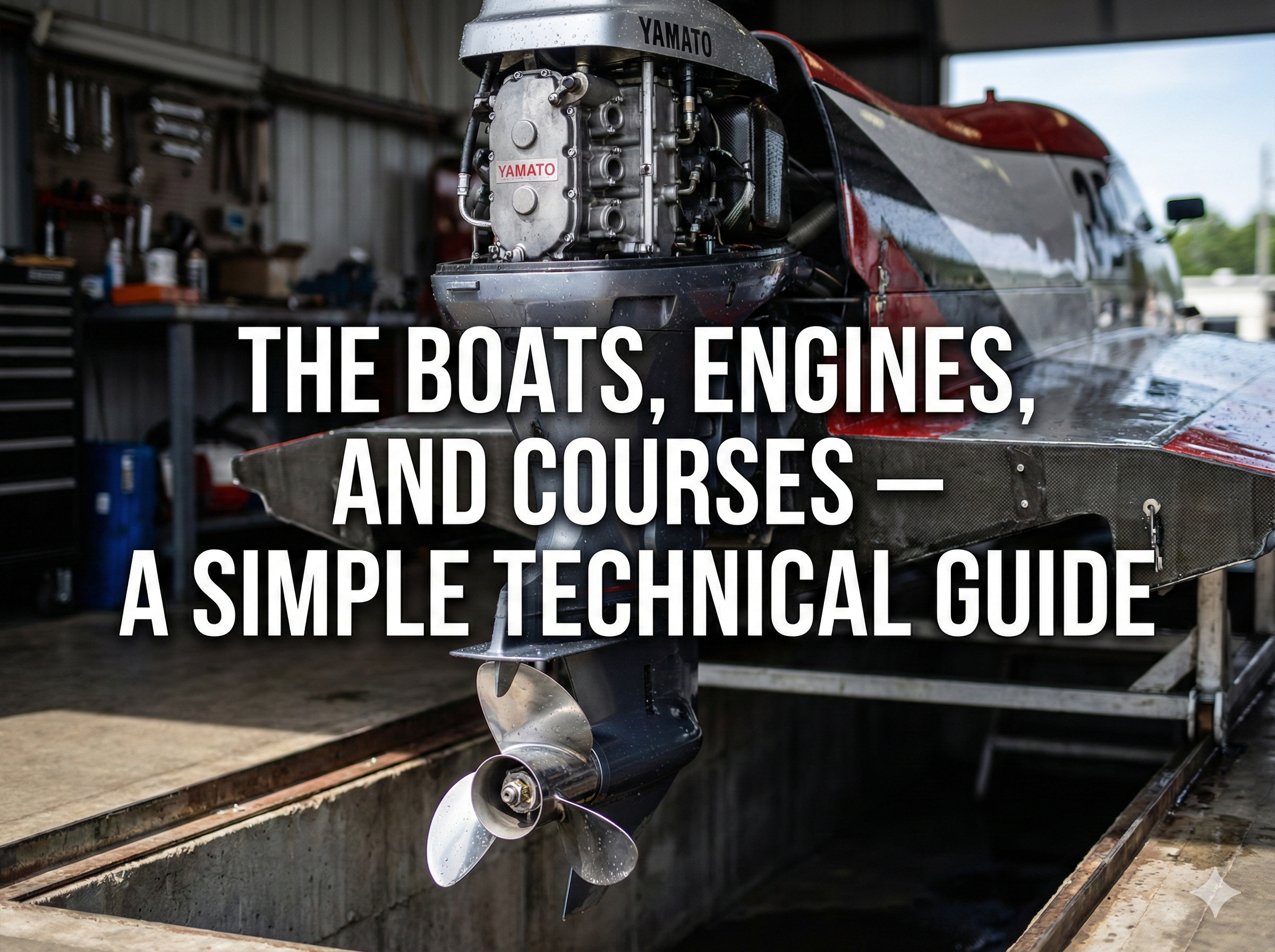
When watching boat racing in Japan, knowing about the shape of the boats, how the engines work, and the structure of the course makes the races more enjoyable. This article explains the technical basics of boat racing in an easy-to-understand way for beginners. When watching races, you'll be able to notice subtle points like “this boat is aiming for the inside course” or “this racer is adjusting the tilt angle.”
1
What Kind of Boats Are Used?
The boats used in boat racing are called “hydroplanes,” designed specifically for gliding over the water surface. They are very compact, with a total length of approximately 3 meters (2,895mm) and a total width of approximately 1.3 meters (1,336mm). The weight is between 68kg and 70kg, and the material is wood (partially composite).
Previously, boats with V-shaped hulls called “runabouts” were also used, but now they have been unified to the hydroplane type, which is suitable for high-speed gliding and minimizes resistance by reducing the contact area with the water. The hull bottom is called a “3-point hydroplane” shape, equipped with a fin (skeg) in the center.
What's interesting is that because the hull is made of wood, it absorbs a small amount of moisture during the race period, causing the weight to change. This is one of the factors that complicates calculations for racers' weight adjustments (ballast loading). Also, there are no braking mechanisms or reverse gears installed at all; deceleration is performed only by throttle-off and water resistance.
All boats used at all race venues are based on the same specifications, and currently, Yamato Motor Co., Ltd. is responsible for manufacturing. The price is approximately 600,000 yen, and there is almost no used market. This philosophy of “one-make (single specification)” eliminates advantages and disadvantages due to equipment, creating a competitive environment where racers' skills and tactical vision determine victory or defeat.
2
Engines and Their Power
The engine, which is the heart of boat racing, is exclusively supplied by Yamato Motor Co., Ltd., headquartered in Ota City, Gunma Prefecture. The “Yamato 331” motor is currently adopted at all 24 boat racing venues nationwide. This model was introduced sequentially from December 2014 (Heisei 26), and its main development goal was “improving safety through output reduction.”
The Yamato 331 is a water-cooled vertical in-line 2-cylinder 2-stroke engine with a total displacement of 396.9cc. The maximum output is 22.8kW (approximately 31PS), generated at 6,600rpm. The maximum torque is 35.8N・m, generated at 6,000rpm. The maximum rotation speed is set at 7,000rpm.
The characteristic of this engine is that it emphasizes “reliability” and “torque characteristics in the mid-to-low speed range” rather than “absolute maximum speed.” Because races are held daily and the motor must run through “heat after heat (race after race)” without failure, it is “over-designed.” In public racing, engine trouble leading to withdrawal directly results in massive losses for the organizers due to refunds of betting tickets (full refunds based on the terms and conditions) to fans. Therefore, Yamato's engineering priority is not “extreme speed” like F1, but “extreme reliability” and “minimization of individual differences.”
Motors are assigned by lottery, but racers are granted the right to “adjust (maintain)” them. The main adjustment tasks performed by racers include carburetor adjustment, propeller modification (a craft called “propeller hammering”), and parts replacement. Through these adjustments, efforts are made to bring a “bad motor” drawn in the lottery closer to an “ace machine.”
3
The Shape of the Course
The boat racing course is 600 meters per lap, and the race is run over 3 laps for a total of 1,800 meters. The distance between the first turn mark and the second turn mark is 300 meters, and the turning direction is counterclockwise (left turn).
The course shape is basically rectangular, but depending on the terrain of each race venue (pool, river, sea), the width of the water surface and the swing width of the first turn mark (how close it is to the stands) differ. This creates venue characteristics such as “inside advantage” and “outside advantage.”
The start method is a unique system called the “flying start method.” Unlike track and field or F1, which start from a stationary position with a “go,” this system requires advanced control of time and space, where racers build up speed beforehand and must pass the start line within 1 second (0.00 seconds to 1.00 seconds) after the large clock (a huge clock over 3 meters in diameter) hand points to 0 seconds (12 o'clock position).
If a boat passes the line earlier than 0.00 seconds (flying) or later than 1.00 seconds (late start), that boat is immediately disqualified and all betting tickets (boat tickets) related to that boat are refunded. This system is one of the characteristics that decisively distinguishes boat racing from other motor sports.
4
Inside vs Outside Lanes
In boat racing, the inside of the course (lanes 1 and 2) is called the “inside course,” and the outside (lanes 4 to 6) is called the “outside course.” Tactics and settings differ greatly between the inside and outside courses.
Inside course racers often use tactics of escaping with tight turns. Therefore, they often set the “tilt angle,” which is an important setting element that determines boat behavior, to -0.5 degrees. When the tilt angle is lowered, the propeller's thrust works to push the boat's bow down, creating behavior that sticks to the water surface. This increases stability during turns and enables sharp turns (monkey turns) from the inside course.
On the other hand, outside course racers often use tactics of aiming for “makuri” (overtaking from the outside). Therefore, they often set the tilt angle to +0.5 to +1.5 degrees. When the tilt angle is raised, the bow lifts up, reducing the contact area with the water, so water resistance decreases and top speed increases. However, stability during turns decreases, so the turning radius at the turn mark becomes larger, and there is a risk that tight turns become ineffective.
“Tilt 3 degrees” (+3.0 degrees) is known as a special setting and is sometimes used at special venues like Edogawa, where the water surface is rough. With this setting, the contact area is minimized, making it a straight-line specialist, but stability during turns is significantly reduced.
5
How Conditions Change the Race
Wind and water surface conditions have a major impact on race development. Racers adjust the carburetor according to changes in temperature, humidity, and atmospheric pressure. Adjustments such as thinning the fuel when the temperature rises (because air density decreases) or enriching it when the temperature drops are made right up until the race.
Water surface conditions are also important. The wake created by the propeller of a leading boat, called “hikinami” (draft wave), is a fatal obstacle for following boats. The wake contains a mixture of water and bubbles (aeration), significantly reducing the propeller's ability to grip the water (traction). This can be understood as a phenomenon close to “cavitation.”
Wind effects cannot be ignored either. When there is a strong headwind, boat speed decreases and fuel consumption increases. When there is a tailwind, speed improves, but boat stability may decrease. Racers read these conditions and choose the optimal settings and tactics.
6
What to Look At During a Race
When watching boat racing, checking the following points will make it more enjoyable.
First, watch the large clock at the start. Racers begin accelerating while watching the large clock hand and try to pass the start line between 0.00 and 1.00 seconds. The psychological battle of trying to cut the start line even 0.01 seconds earlier and reach the first turn mark is one of the highlights of boat racing.
Next, pay attention to the battle at the first turn mark. It is said that 80% of boat racing victories and defeats are decided at the “first turn mark.” The battles here involve deep hydrodynamic interactions. The “nige” (escape) tactic, where the boat in lane 1 turns the turn mark first without receiving anyone's draft wave, is overwhelmingly advantageous because it can turn in the cleanest water surface condition.
Also, pay attention to the technique called “monkey turn.” This is an essential technique in modern boat racing where the racer stands up on the boat and moves their weight significantly to the inside of the turn. In a normal seated posture, the boat tends to be pushed outward by centrifugal force, but by offsetting the center of gravity (CG) to the turn center side through the monkey turn, it's possible to counteract centrifugal force and make sharp turns while maintaining high speed.
Furthermore, you can also guess what kind of setting (tilt angle) a racer is using from the boat's behavior. If it behaves as if sticking to the water surface, it's “de-ashi type” (quick start type), and if it moves as if bouncing on the water, it's “nobi type” (stretch type).
7
Frequently Asked Questions
All boats used at all race venues are based on the same specifications, and Yamato Motor Co., Ltd. is responsible for manufacturing. Advantages and disadvantages due to equipment are eliminated, and racers' skills and tactical vision determine victory or defeat.
The Yamato 331 motor currently in use has a maximum output of 22.8kW (approximately 31PS), generated at 6,600rpm. The maximum torque is 35.8N・m, generated at 6,000rpm.
The race is run over 3 laps of a 600-meter course for a total of 1,800 meters. The distance between the first turn mark and the second turn mark is 300 meters.
The inside course (lanes 1 and 2) is suitable for tactics of escaping with tight turns, while the outside course (lanes 4 to 6) is suitable for tactics of aiming for “makuri” (overtaking from the outside). Each has different appropriate settings (tilt angle).
If a boat passes the line earlier than 0.00 seconds (flying) or later than 1.00 seconds (late start), that boat is immediately disqualified and all betting tickets (boat tickets) related to that boat are refunded.
- BOAT RACE Official Website
- RPM Marine - Yamato Outboard Motors
- American Power Boat Association
- Race World Offshore
- BOAT RACE
- Miyajima Kyotei Freaks
- Yamato
- RPM Marine - Yamato 102 Outboard Racing Motor
- Keirin Summit
- BOAT RACE Official Website
- Kyotei Navi
- Japan Motorboat Racing Association
- Yamato
- US Coast Guard
- BOAT RACE Official Website
- BOAT RACE TOKUYAMA
- Motorboat Racing Competition Inspection Regulations
- US Sailing
- RPM Marine - Yamato Outboard Motors Supplier and Services
- American Power Boat Association