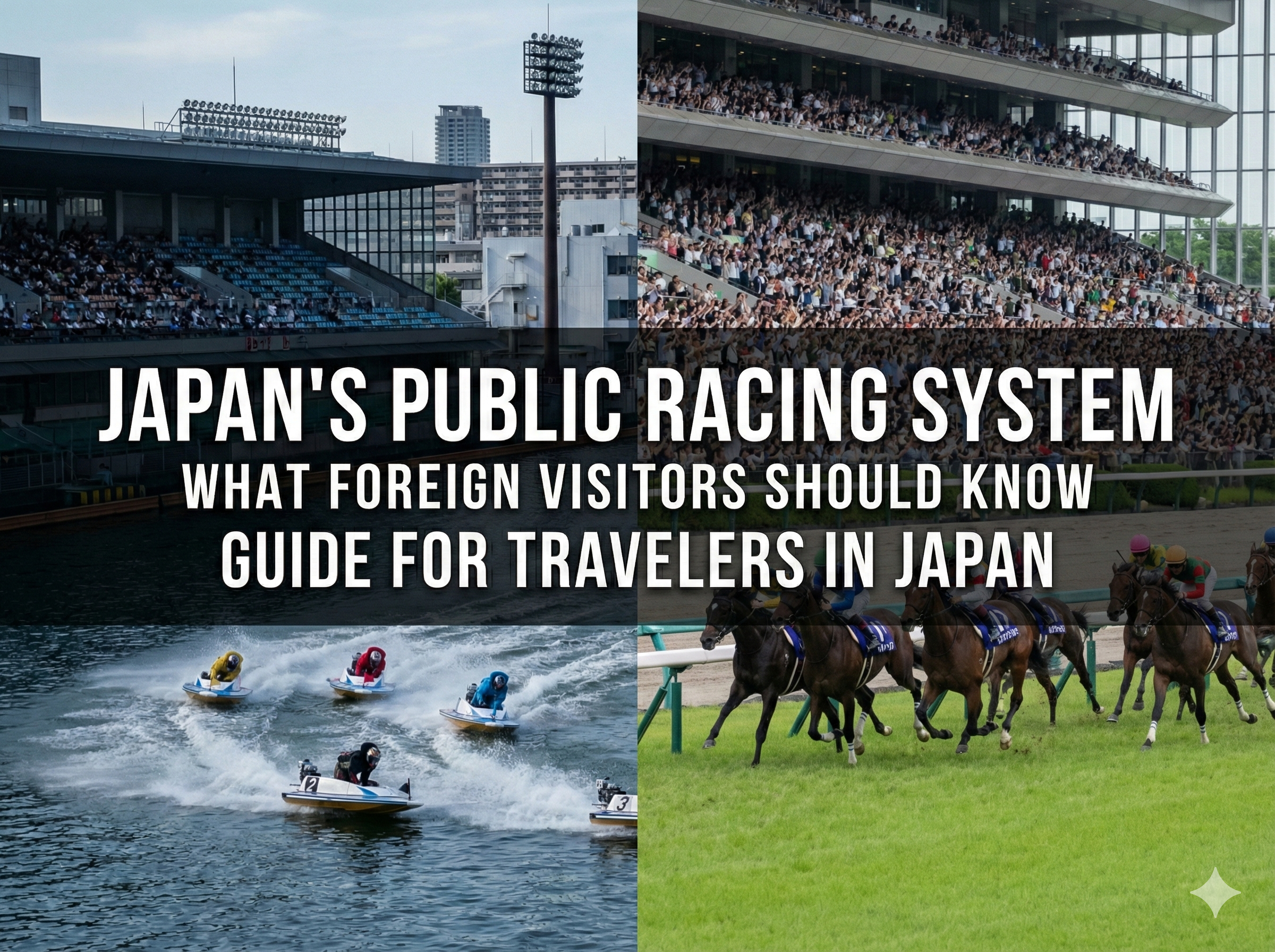
Hello, travelers visiting Japan. Did you know that Japan has a unique racing system called "public racing" (公営競技)? These competitions, including boat racing, are not just entertainment but special entities deeply rooted in Japanese law and social systems. This article explains what public racing is, what types exist, and how the revenue is used, from a traveler's perspective. We hope this serves as foundational knowledge to help you better understand your experience in Japan.
Table of Contents
1
What Is "Public Racing" in Japan?
In Japan, gambling is generally prohibited under Article 185 of the Penal Code. However, to secure post-war reconstruction funds and promote related industries, a system called "public racing" (Public Sports) was established that legalizes gambling only when based on specific legal foundations. These are the four competitions: horse racing, keirin (bicycle racing), auto racing, and boat racing (motorboat racing).
These competitions are positioned not as mere private profit-making businesses but as public welfare undertakings involving the state and local public bodies. Each competition is under the supervision of a different government ministry, and the differences in their legal foundations and supervising ministries reflect the industrial backgrounds that led to their establishment.
Boat racing is governed by the Ministry of Land, Infrastructure, Transport and Tourism (formerly the Ministry of Transport) under the Motorboat Racing Act enacted in 1951 (Showa 26). It was established to maintain and improve shipbuilding technology after the war, promote maritime awareness, and improve local finances. Horse racing is supervised by the Ministry of Agriculture, Forestry and Fisheries, while keirin and auto racing are supervised by the Ministry of Economy, Trade and Industry, each with their own industrial promotion purposes.
In this way, public racing operates as a "public" enterprise, with its revenue returned to public benefit. For travelers, understanding this as part of Japan's social system rather than just gambling will help you appreciate it better.
2
Types of Public Races (Boats, Horses, etc.)
Japan has four main types of public racing, each with distinct characteristics and different supervising ministries.
Boat Racing (競艇): A water sport supervised by the Ministry of Land, Infrastructure, Transport and Tourism. Six boats compete in fixed races, racing three laps counterclockwise around a 600-meter course. Total sales in fiscal 2024 were approximately 2.5 trillion yen, making it the second-largest public racing market. It is a fast-paced competition where the battle at the first turn mark largely determines the outcome.
Horse Racing (Central & Local): A competition supervised by the Ministry of Agriculture, Forestry and Fisheries, with up to 18 horses racing. Races are held on turf or dirt tracks, with stamina and straight-line speed being key factors. With sales of approximately 3.3 trillion yen, it forms the largest market among public racing.
Keirin: A bicycle racing competition supervised by the Ministry of Economy, Trade and Industry, with 7 or 9 riders competing. Races are held on banked (concrete) tracks, characterized by strong team elements called "lines." Sales are approximately 1.3 trillion yen.
Auto Racing: A motorcycle racing competition supervised by the Ministry of Economy, Trade and Industry, with 8 riders competing. Races are held on asphalt-paved tracks, characterized by handicap races and high-speed laps. Sales are approximately 109.1 billion yen, the smallest among the four competitions.
Boat racing uses six boats, giving it the highest hit rate among competitions, contributing to its "ease of play." It also has fewer team elements than keirin, being essentially an individual competition, making prediction logic relatively simple for beginners. The parallel start format (except for fixed-entry races) also makes it visually easy to understand the positions.
3
Who Operates Boat Races?
Boat racing operators (organizers) are legally limited to "local public bodies (municipalities or prefectures)" and "partial affairs associations." This embodies the "public" principle of attributing gambling revenue to local governments, representatives of public interest, rather than private companies.
Currently, there are 24 boat racing venues across Japan, all managed and operated by local governments in their respective regions (e.g., Omura City, Osaka Prefecture Urban Boat Racing Association, which includes Suminoe Ward). Operators have the right to hold races while bearing the obligation to maintain fair operations, with supervisory authority held by the Ministry of Land, Infrastructure, Transport and Tourism.
This "municipal operation principle" means boat racing revenue functions as a "second tax revenue," directly allocated to public infrastructure such as school construction, road maintenance, and water and sewer expansion. Some of the infrastructure in Japanese cities that travelers visit may actually be supported by boat racing revenue.
4
Where the Money Goes
Boat racing's economic model adopts the parimutuel betting system. This is a method where the remainder after deducting the organizer's share (deduction amount) from total sales is distributed as payouts to winners. Boat racing has a payout rate of approximately 75%, with the remaining 25% deducted for operating expenses and public purposes.
The breakdown of this 25% deduction is as follows. Approximately 3.1% goes to the Nippon Foundation for funding a wide range of social contribution activities such as ship-related business promotion, maritime accident prevention, child support, disaster recovery, and international cooperation. Approximately 1.3% goes to the Japan Motorboat Racing Association for fair race operations, placement of judges and inspectors, athlete management, and motor and boat inspection operations. Approximately 0.3% goes to the Local Government Finance Corporation as interest subsidy funds for local bonds related to public enterprise development such as water and sewer systems and public hospitals. The remainder goes to operating expenses (prize money for athletes, employee salaries, facility maintenance costs, advertising expenses, etc.) and operator (municipal) revenue, which is transferred to general accounts and used as financial resources for public services such as education, civil engineering, welfare, and medical care.
What is particularly noteworthy in this structure is the existence of the Nippon Foundation (formerly: Japan Shipbuilding Industry Foundation). The system that automatically delivers approximately 3% of sales to this foundation was established by Yoichi Sasakawa, a key figure in boat racing's creation. This means boat racing revenue is not limited to municipal "pocket money" but flows as funds for solving global-scale challenges such as leprosy eradication activities and marine environment conservation. In other words, purchasing boat racing tickets can be seen as structurally containing aspects of indirect "donation behavior."
5
What This Means for Visitors
Foreign travelers visiting Japan can legally purchase tickets and receive payouts at racing venues and off-track betting facilities (Boat Pia), just like Japanese people. There are no restrictions based on nationality; only the age limit (20 years or older) applies.
Major racing venues (such as Heiwajima and Fukuoka) provide multilingual "beginner's guides" in English, Chinese, Korean, and other languages, explaining how to fill out mark cards (betting cards). For foreigners who cannot read Japanese, betting cards written in kanji are difficult, but you can mark "venue code," "race number," "bet type," "boat number," and "amount" while referring to color-coded guidebooks.
However, to use Teleboat (official internet betting), opening a Japanese bank account or domestic residence verification is required, making it effectively impossible for short-term travelers to participate online. Also, access from overseas (cross-border betting) is blocked by IP restrictions, and it is not recommended as it may violate gambling laws in your country of residence.
At many racing venues, filming the races themselves is permitted, but there are strict restrictions on including other spectators in shots to protect their privacy. Consideration is also required when uploading to social media. Also, unlike the social atmosphere of European and American racetracks, Japanese boat racing venues are essentially entertainment facilities for the general public. Alcohol is sold, but entry may be refused if you are intoxicated.
Author's
Comment
6
Frequently Asked Questions
Yes, it's possible. There are no restrictions based on nationality, and anyone 20 years or older can purchase tickets and receive payouts at racing venues and off-track betting facilities.
For short-term travelers, online betting is effectively difficult as it requires opening a Japanese bank account or domestic residence verification. We recommend purchasing at local racing venues or off-track betting facilities.
Approximately 25% of sales are deducted, with about 3.1% going to social contribution activities through the Nippon Foundation, and the remainder used as financial resources for local government public services.
Boat racing features six boats with a high hit rate and is essentially an individual competition, making it easy to understand for beginners. It is also the only public racing supervised by the Ministry of Land, Infrastructure, Transport and Tourism.
Filming the races themselves is permitted, but there are strict restrictions on including other spectators in shots to protect their privacy. Consideration is also required when uploading to social media.
References
- Maritime: Motorboat Racing - Ministry of Land, Infrastructure, Transport and Tourism
- How Boat Racing Works | What is Boat Racing? | BOAT RACE Promotion Association
- Which Ministry Governs Public Gambling? / Homemate - Prefectural Government / Ministry
- Which Ministry Governs Keirin, Boat Racing, and Horse Racing? Thorough Explanation of Public Gambling and Politics
- National Association of Racing (NAR; operated by Local Governments) JRA Racing (operated by the Japan Racing Association) - Horse Racing in Japan
- About Boat Race | BOAT RACE – Get a splash on the action!
- BOAT RACE Official Website
- A beginner's guide to Boat Race in Japan
- BOAT RACE Heiwajima | How to Enjoy Heiwajima
- A beginner's guide to Boat Race in Japan
- How to Bet | BOAT RACE – Get a splash on the action!
- BOAT RACE TODA Official Website - Boat Race Toda
- BOAT RACE Heiwajima | Types of betting tickets
- BASIC KNOWLEDGE of BOAT RACE - Boat Race Marugame