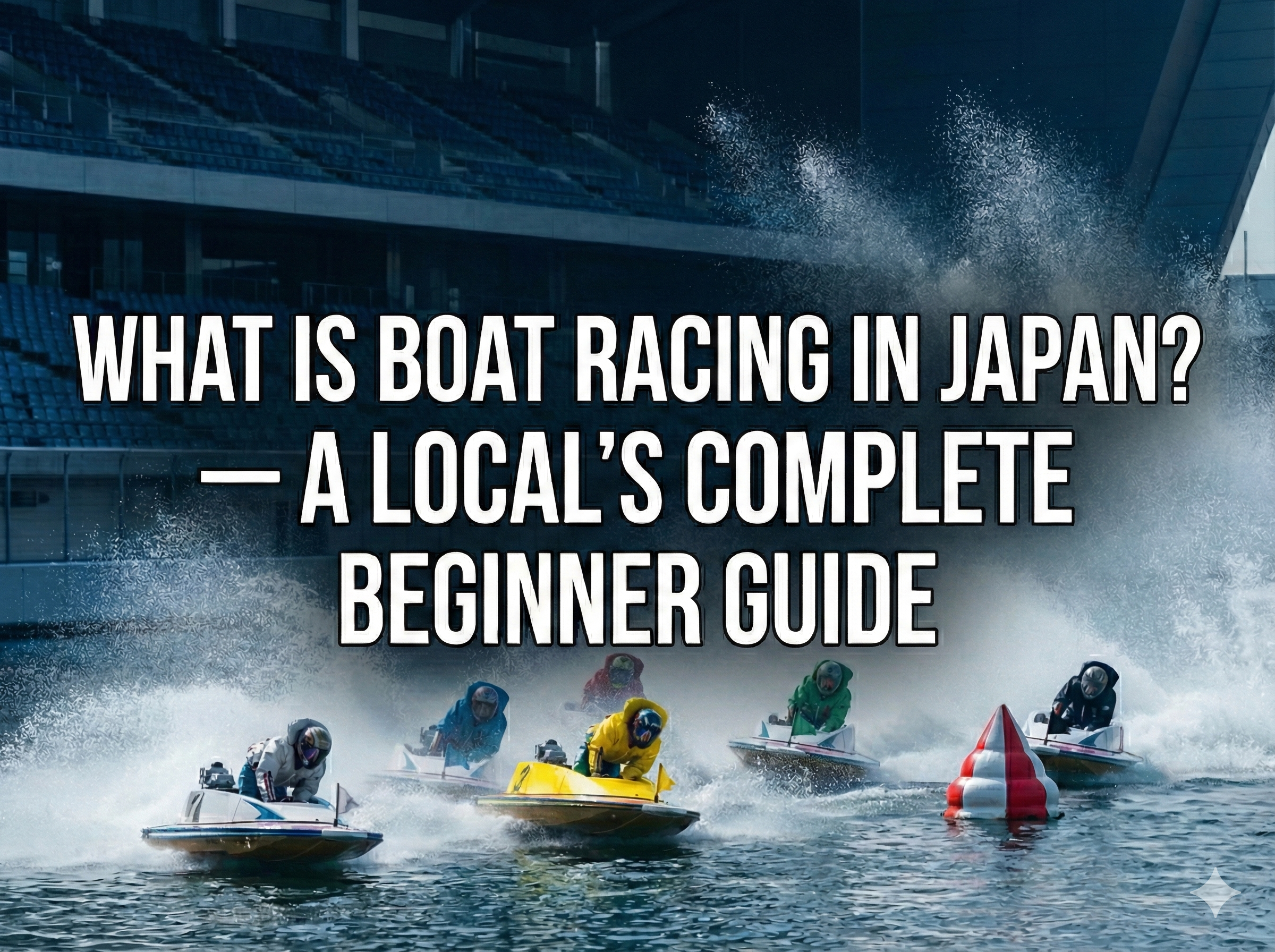
Hello, foreign travelers visiting Japan. This article is a gentle introduction to boat racing in Japan (formerly known as "kyotei") for those learning about it for the first time. This article covers everything beginners want to know about boat racing, from its historical background and basic mechanics to the atmosphere of races and how to enjoy them. Boat racing, one of Japan's unique public sports competitions, is not just gambling but also a culture deeply integrated into regional economies and public welfare activities. We hope you'll discover the world of boat racing through this article.
Table of Contents
- What Exactly Is Boat Racing in Japan?
- Why It Exists: A Short History
- How It Works: Rules Made Simple
- Fairness and Transparency in the System
- Boat Racing vs Horse Racing and Other Sports
- What It Feels Like at a Japanese Boat Race Venue
- Is It Gambling? Understanding the Legal Side
- Why Many Foreign Visitors Find It Fascinating
- Common Misunderstandings Beginners Have
- Where to Go Next: Guides for Beginners
- Frequently Asked Questions
1
What Exactly Is Boat Racing in Japan?
Boat racing is a Japanese public sports competition in which six hydroplanes (motorboats) race around a 600-meter water course three times (1,800 meters total) to compete for ranking. It is under the jurisdiction of the Ministry of Land, Infrastructure, Transport and Tourism, and local governments serve as organizers (operators) to hold races. There are 24 boat racing venues nationwide, each with its own unique characteristics.
The most distinctive feature of boat racing is its unique rule called the "flying start system." The start line is measured in 0.01-second units, and the boat that crosses the start line fastest gains an advantage. The tension of competing for this 0.01 second is one of the highlights of boat racing.
Boat racing is operated under the "Motorboat Racing Act" enacted in 1951, established to secure financial resources for post-war reconstruction. Since then, it has formed a unique industrial ecosystem as a source of funds for local government fiscal reconstruction, shipbuilding industry promotion, and social contribution activities through the Nippon Foundation.
2
Why It Exists: A Short History
The history of boat racing is closely linked to Japan's post-war reconstruction. In June 1951, the "Motorboat Racing Act" was enacted to rebuild devastated local finances after the war and revive the shipbuilding industry, which had suffered devastating damage. This law was groundbreaking in that it allowed local governments to serve as organizers (operators) and use the proceeds for public works and social welfare.
In April 1952, the first motorboat race in history was held at Omura Race Course in Nagasaki Prefecture. Initially, awareness was low and operations were exploratory, but the unique use of water surfaces and the sense of speed gradually captured public interest.
An important turning point was the establishment of the "Japan Shipbuilding Industry Foundation" (now the Nippon Foundation) in 1962. Under the leadership of its first chairman, Ryoichi Sasakawa, boat racing proceeds (grants) expanded beyond domestic shipbuilding promotion to international humanitarian aid and infrastructure development. Notable examples include support for the 1964 Tokyo Olympics and the Malacca-Singapore Strait navigation improvement project (started in 1969), which is crucial for Japan's energy security. This strengthened boat racing's legitimacy as a "business that serves national interests," not just gambling.
From the 1980s onward, convenience improved through technological innovations such as the introduction of telephone voting systems and the adoption of mark card methods (1992). However, sales temporarily declined due to the diversification of leisure activities. In response, the industry undertook a major brand refresh in the 2010s. The name was unified from "kyotei" to "BOAT RACE," with a new logo design, the use of famous celebrities in TV commercials, and expanded night racing. This was a strategic decision to transform from the previous "gambling den" image into entertainment that couples and young people can enjoy casually.
3
How It Works: Rules Made Simple
Boat races proceed as follows. First, six hydroplanes line up at the start line. The start uses a "flying start system," measured in 0.01-second units. The boat that crosses the start line fastest gains an advantage, but if the start is too early, it results in a "flying" (false start) and disqualification.
The race consists of three laps around a 600-meter course (1,800 meters total). Turn marks (rotating markers) are placed on the course, and each boat must turn left around these marks. Failing to properly round the turn marks also results in disqualification.
During the race, each boat runs at high speed, skimming across the water surface. The characteristic of hydroplanes is that they rise above the water surface to run, allowing them to travel at very high speeds. Race results are determined by the order in which boats reach the finish line.
Betting (purchasing boat tickets) offers multiple betting methods, such as "sanrentan" (predicting 1st, 2nd, and 3rd place in order) and "nirenfuku" (predicting 1st and 2nd place). If you win, you receive a payout based on your purchase amount.
4
Fairness and Transparency in the System
The fairness and transparency of boat racing are protected by strict systems. First, there is a motor lottery system. The motors used by each boat are determined by lottery before the race. This prevents specific boats from always having an advantage.
Additionally, athlete management is strict. The Japan Motorboat Racing Association serves as the sole racing implementation organization, conducting judging, inspections, athlete management, and training. Athletes are recognized as professionals after rigorous screening and training.
To ensure race fairness, start judgments are made using electronic equipment. Judgments in 0.01-second units eliminate errors from human visual inspection. Also, if a disqualification occurs due to a flying start or late start, all tickets related to that boat are fully refunded. While this represents a loss of opportunity for operators, fair start management is also the most important management issue.
The Ministry of Land, Infrastructure, Transport and Tourism serves as the supervisory authority, overseeing the fair and safe implementation of races. In this way, multiple organizations work together to ensure the fairness and transparency of boat racing.
5
Boat Racing vs Horse Racing and Other Sports
Boat racing has several distinctive differences compared to horse racing and other public sports competitions. First, the stage is "water." While horse racing takes place on land at racecourses, boat racing uses water surfaces, so weather and water conditions significantly affect race results.
Next, there is a difference in start methods. Horse racing typically uses a "gate start" where all horses start simultaneously. In contrast, boat racing uses a "flying start system" measured in 0.01-second units, where the boat that crosses the start line fastest gains an advantage. This difference affects race strategy and how spectators enjoy watching.
Additionally, boat racing is a public sports competition under the "Motorboat Racing Act," while horse racing is under the "Horse Racing Act." They operate under different laws, with different revenue distribution structures and operational systems.
Boat racing revenue returns approximately 75% of sales as payouts, with the remaining approximately 25% as the deduction rate. This deduction rate is standard compared to other public sports competitions and lotteries. Part of the revenue is allocated through the Nippon Foundation to support marine and shipbuilding projects, social welfare, and international cooperation.
6
What It Feels Like at a Japanese Boat Race Venue
Boat racing venues are places where you can enjoy not only watching races but also various facilities. Many boat racing venues have paid seats, restaurants, and shops, allowing you to enjoy yourself all day.
The atmosphere of racing venues has changed from the previous "gambling den" image to entertainment spaces where couples and young people can enjoy themselves casually, thanks to recent brand refresh efforts. Night racing has also been expanded, making it possible to enjoy races at night.
When watching, you first purchase boat tickets at the betting counter. There are multiple betting methods, and beginners are recommended to try "sanrentan" or "nirenfuku." When the race begins, six boats line up at the start line and start with a flying start. During the race, focusing on the positional relationships of the boats and how they round the turn marks makes it more enjoyable.
Racing venues have large screens installed, displaying race conditions and information about each boat in real time. There is also live commentary that explains the race developments in an easy-to-understand manner.
Author's
Comment
7
Is It Gambling? Understanding the Legal Side
Boat racing is legally positioned as a "public sports competition" and is operated under the "Motorboat Racing Act." This law allows local governments to serve as organizers and use the proceeds for public works and social welfare.
Boat racing revenue returns approximately 75% of sales as payouts, with the remaining approximately 25% as the deduction rate. Part of this deduction rate is used as a source of funds for local government fiscal reconstruction, shipbuilding industry promotion, and social contribution activities through the Nippon Foundation.
In recent years, the fulfillment of social responsibility based on the Basic Act on Measures to Prevent Gambling Addiction has also been strengthened. The boat racing industry collaborates with the Gambling Addiction Prevention and Recovery Support Center to conduct awareness campaigns on addiction measures. Additionally, each racing venue provides guidance to promote appropriate use and information about addiction.
Boat racing is not just gambling but also a culture deeply integrated into regional economies and public welfare activities. However, betting (purchasing boat tickets) should be done at your own responsibility, and excessive use should be avoided.
Author's
Comment
8
Why Many Foreign Visitors Find It Fascinating
In recent years, boat racing has gained attention from foreign travelers. One reason is the brand refresh in the 2010s. The name change from "kyotei" to "BOAT RACE," new logo design, and enhanced multilingual support have created an environment more familiar to foreign travelers.
Additionally, boat racing is attractive as a unique Japanese cultural experience. The power of hydroplanes racing at high speed across water, the tension of competing for 0.01 seconds, and the unique atmosphere of racing venues offer a fresh experience for foreign travelers visiting Japan.
Furthermore, boat racing venues also function as tourist spots. Many boat racing venues are located near urban areas and tourist destinations, making them easy to visit during sightseeing. Venues have restaurants and shops, so you can enjoy not only race watching but also dining and shopping.
The official boat racing website has comprehensive English guides, providing information for foreign travelers. Additionally, some racing venues offer tours and experience programs for foreigners.
9
Common Misunderstandings Beginners Have
Here are some common misunderstandings beginners have about boat racing. First, the misconception that "boat racing is complex and difficult." While betting methods and rules have complex aspects, the basic flow is simple. The basic mechanism of six boats racing and betting on the predicted order is easy for beginners to understand.
Next, the misconception that "boat racing venues are dangerous places." While there was a "gambling den" image in the past, recent brand refresh efforts have transformed them into entertainment spaces where couples and young people can enjoy themselves casually. Racing venues are equipped with safe and comfortable environments, so even first-time visitors can enjoy them with peace of mind.
There is also the misconception that "boat racing always makes money." Betting (purchasing boat tickets) is a means to enjoy races more, not a way to make profits. While payouts are made when you win, you won't necessarily make a profit. It's important to set a budget before participating and enjoy it within appropriate limits.
Finally, the misconception that "boat racing is only for men." In recent years, the number of female spectators has increased, and environments where couples and families can enjoy themselves have been established. Night racing has also been expanded, making it possible to enjoy races at night.
10
Where to Go Next: Guides for Beginners
For those who want to learn more about boat racing, we recommend the following articles. These articles provide more practical information on betting methods, how to choose racing venues, tips for watching, and more.
- Complete Guide to Boat Racing Betting Methods (For Beginners)
- Recommended Boat Racing Venue Guide (By Region)
- Tips and How to Enjoy Boat Racing
- Boat Racing Glossary (For Beginners)
We hope these articles will help you understand the world of boat racing more deeply and serve as a reference when you actually visit a racing venue.
11
Frequently Asked Questions
There is no age restriction for entering boat racing venues, but betting (purchasing boat tickets) is available from age 20. Minors may need to be accompanied by a guardian.
There are 24 boat racing venues nationwide. Major venues are located near urban areas and tourist destinations, such as Heiwajima in Tokyo, Suminoe in Osaka, and Wakamatsu in Fukuoka.
Race start times vary by venue and event date. Typically, there are daytime events and night events, with night events held in the evening. Details can be checked on each venue's official website.
There are multiple betting methods. Beginners are recommended to try "sanrentan" (predicting 1st, 2nd, and 3rd place in order) or "nirenfuku" (predicting 1st and 2nd place). You can ask staff at the betting counter for detailed explanations.
The official boat racing website has comprehensive English guides. Additionally, some racing venues have guide pamphlets for foreigners and multilingual information boards.