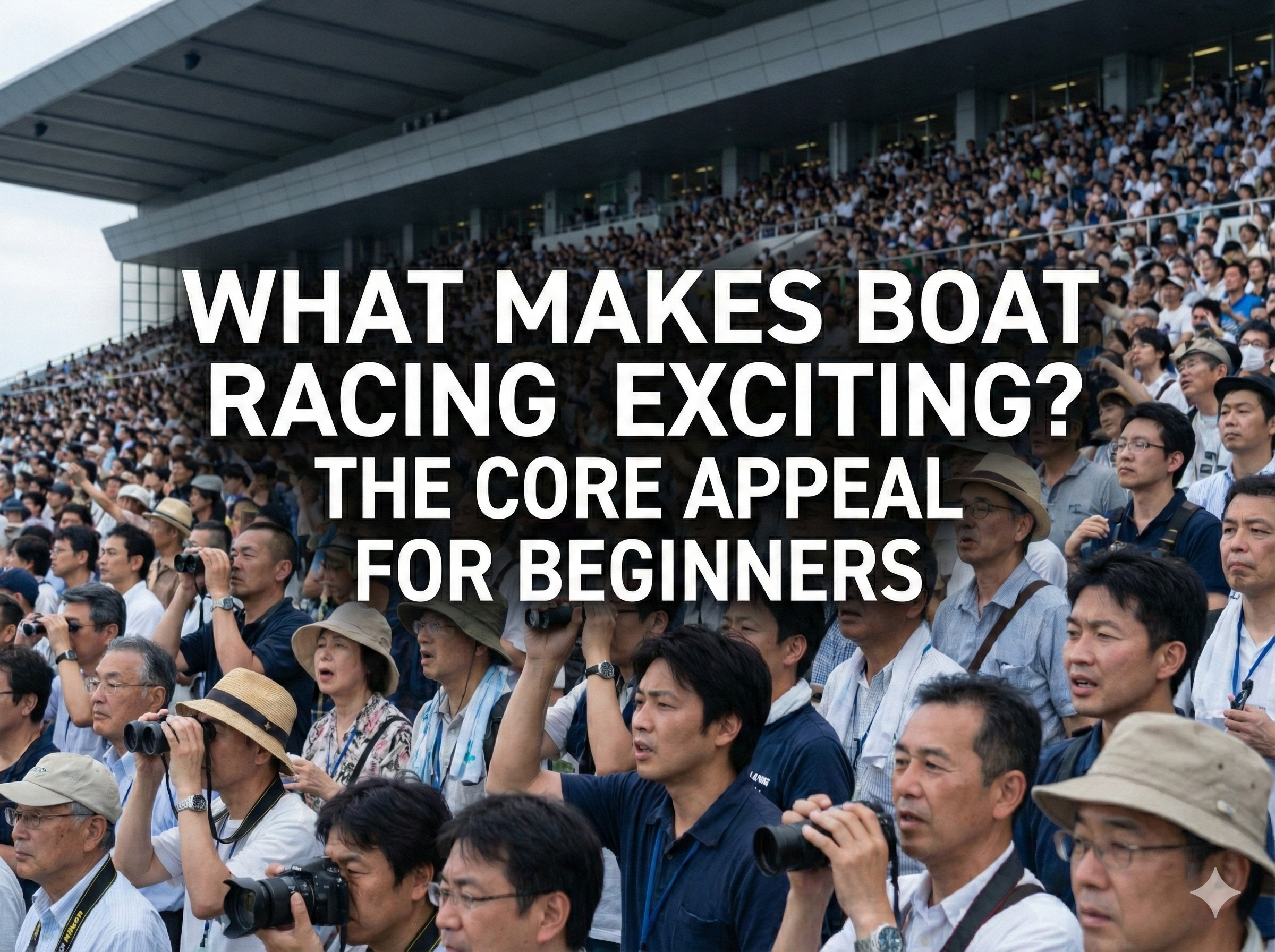
Boat racing is a public sports competition that has evolved uniquely in Japan. Boats gliding across the water at speeds exceeding 80 km/h, engines roaring with thunderous sounds, and the strategic battle for a 0.01-second advantage at the start. For first-time visitors, boat racing is a thrilling form of entertainment that is completely different from "rowing boats." In this article, we explain the appeal of boat racing for beginners from the perspective of a Japanese host. We will share the six key points that we want first-time visitors to experience: the sense of speed, strategic battles, and the unity of the venue atmosphere.
Table of Contents
1
Speed and Sound on the Water
The essence of boat racing's appeal lies in the physical behavior of gliding at ultra-high speeds across unstable water surfaces and the sensory stimulation that accompanies it. The boats used employ a special hull design called "Hydroplane," where at top speed, only a small part of the propeller and stern touches the water surface, while most of the hull is airborne. This structure minimizes water resistance to the extreme, allowing wooden boats approximately 2.9 meters long and weighing about 70 kilograms (excluding the motor) to reach speeds exceeding 80 km/h. Due to the low viewpoint near the water surface and the direct vibration without suspension, the racers' perceived speed is said to exceed 120 km/h.
The first impact that first-time visitors to a boat racing venue experience is the "sound." The high-pitched, dry exhaust note characteristic of two-stroke engines creates such sound pressure when six boats accelerate simultaneously at the start or turn around turn marks at full speed that it vibrates the air in the stands. Particularly, the thunderous roar when the large clock's hand points to zero and all boats rush into the first turn mark at full throttle instantly heightens the audience's adrenaline. Additionally, in night races (such as Gamagori, Marugame, and Shimonoseki), the thunderous sounds echoing through the darkness combined with the lighting effects of water spray create a surreal atmosphere that appeals to both sight and hearing.
Interestingly, while motorsports like F1 use cutting-edge materials such as carbon fiber, boat racing hulls remain wooden. This is due to a combination of reasons: shock absorption, ease of repair, and the inheritance of manufacturing techniques to maintain equal conditions across all racing venues nationwide. The contrast of wooden boats built by craftsmen being controlled with cutting-edge technology also reflects the Japanese spirit of "monozukuri" (craftsmanship).
2
Close Battles at the Turns
What captivates audiences more than straight-line speed battles and determines victory or defeat is cornering (turning). Since there is no grip like high-friction asphalt on the water surface, turning a boat at high speed requires extremely advanced physical control and physical ability.
In the past, boat racing turns were mainly done in a style close to sitting in a formal position on the boat, turning only by shifting body weight. However, the appearance of the "Monkey Turn," developed by racer Kaichi Iida, completely changed the nature of the competition. The Monkey Turn is a technique where the racer stands up on the boat during a turn, assumes a half-crouched posture while bracing the outer leg, and shifts body weight significantly to the inside. By adopting this posture, racers enjoy physical advantages such as maximizing center of gravity movement, shock absorption, and minimizing water contact area. Today, techniques have evolved further, with new turning theories being developed by younger racers, including "full-speed turns" that maintain full speed while turning around turn marks, and "wheelie turns" that lift the bow to minimize water contact resistance.
Boat racing is a competition where "leading and running away" is overwhelmingly advantageous. Since receiving wake from other boats puts one at an extreme disadvantage, all racers aim to take the lead at the first turn mark (the first corner after the start). It is said that approximately 70-80% of the race outcome is determined at this moment. The audience concentrates all their attention on the few seconds from the start to the first turn mark. The "nige" (escape) where boats on the inside course (in-course) try to take the shortest route, the "makuri" (overtaking) from the outside trying to cover with speed, and the sharp "sashi" (thrust) or "makuri-sashi" (overtaking thrust) into the gap. These multiple tactics intersect, and a momentary misjudgment or delayed steering determines the order. This condensed drama is the highlight of boat racing spectating.
Additionally, racers hammer the propellers given to them with their own hands, modifying the shape in millimeter units. Through this "propeller adjustment," they set up whether to prioritize straight-line speed or turn grip. During demonstration runs (trial runs before the race), fans watch closely to gauge the results of this adjustment, observing engine sounds and boat behavior. This is equivalent to racers doing the work of F1 pit crews themselves, meaning that boat racers must be engineers as well as athletes.
3
Strategy Behind the Start
The decisive difference between boat racing and other motorsports or track and field events lies in its start method. This system, called the "Flying Start," is the most difficult to understand for beginners, yet it provides the greatest excitement once understood.
Unlike track and field events that start from a stationary position with "ready, set, go," boat racing requires boats to pass the start line within a specified time period (between when the large clock's hand points to 0 seconds and within 1 second). Since boats have no brakes and it is difficult to stay in a fixed position due to water currents and wind, racers move away from the start line, secure a running distance, and then begin accelerating in sync with the large clock's hand. Starting too early results in a "Flying (F)," and starting too late results in a "Late Start (L)," both resulting in disqualification.
When a flying or late start occurs, all tickets for that boat are refunded. This means losses ranging from tens of millions to hundreds of millions of yen for the organizers, so extremely heavy penalties are imposed on violating racers. Specifically, these include suspensions of 30 days or more and refusals to arrange participation in grade races for a certain period—penalties directly affecting racers' careers and annual income. Nevertheless, racers push the limits to pass the start line even 0.01 seconds earlier. This is because a 0.1-second delay leads to a decisive disadvantage at the first turn mark. This battle of fractions of a second where "fear for one's livelihood" and "determination to win" intersect truly resembles a game of chicken.
The race begins with a pit out (departure from the starting dock), but racers do not immediately head to the start line. During a period called "waiting action," racers engage in psychological warfare to secure advantageous courses (usually the inside). Since Course 1 has an overwhelmingly high win rate in boat racing (exceeding 50% at some venues), even racers in outer positions (such as Boat 6) may attempt "maetsuke" (moving forward) to get into the inside course when there's an opportunity. However, trying too hard to take the inside course risks bringing the boat too close to the start line during waiting action, preventing sufficient running distance (this is called "fuka-in" or deep inside). "I want the inside, but I don't want to go too deep." In this dilemma, racers read each other's expressions and boat directions to determine their final start position (entry course). Spectators can read the racers' personalities, strategies, and determination during these few minutes before the race begins.
4
Atmosphere in the Stands
While boat racing venues were once called "gambling dens" and had a rough image, they have now changed significantly. Through facility renovations, improved services, and coexistence with local communities, they have evolved into entertainment spaces that welcome diverse groups.
There are 24 boat racing venues across Japan, each with unique geographical and cultural characteristics. Urban types (such as Heiwajima and Suminoe) are located in major metropolitan areas with easy access, bustling with office workers after work and young people. Particularly, Boat Race Heiwajima has good access from Haneda Airport, with natural hot springs and commercial facilities (BIG FUN Heiwajima) adjacent, forming a comprehensive leisure area. Scenic types (such as Naruto, Miyajima, and Hamanako) are located in scenic spots, allowing visitors to enjoy race viewing and tourism together. From Boat Race Naruto, you can see whirlpools, and from Miyajima, you can view the torii gate of the World Heritage Site Itsukushima Shrine.
The atmosphere inside combines the "Showa" era of old Japan with modern "comfort." Each venue has signature dishes. Heiwajima's "nimono" (offal stew), Tamagawa's "gyusui" (beef stew), and Kojima's "tako meshi" (octopus rice) are affordable, hearty dishes that have been loved as energy sources for the working class. These offer a deep side of Japanese food culture. On the other hand, paid reserved seat areas are as refined as airport lounges. Equipped with Wi-Fi, power outlets, free soft drinks, and personal monitors, they allow you to immerse yourself in data analysis in a quiet environment. For foreign tourists, we strongly recommend using these seats (approximately 1,000 to 3,000 yen) to avoid crowds and enjoy comfort.
Modern boat racing venues function as cores of local communities beyond being gambling facilities. "Mooovi," indoor playgrounds for children attached to many venues, are equipped with educational toys and large play equipment, bustling with families on weekends. This has successfully dispelled the traditional stigma that "gambling = bad influence on children" and attracted family groups. Additionally, events such as talk shows by famous celebrities, hero shows, and food festivals are frequently held, creating opportunities for people uninterested in racing to visit.
5
Small Bets, Big Emotions
Boat racing is an entertainment that can be enjoyed starting from just "100 yen," and its betting system (voting method) is easy to understand for beginners while also being profound.
Unlike horse racing (up to 18 horses) or keirin (9 bicycles), boat racing always involves "6 boats." This is the biggest advantage for beginners. Win betting has a 1/6 probability, and Trifecta (predicting 1st, 2nd, and 3rd place in order) has a 1/120 probability. Compared to horse racing's Trifecta (maximum 1/4896), the ease of winning is obvious. The success experience of "winning" is an important element that enhances immersion in the game. Furthermore, since there is a clear theory that "Boat 1 (white) is overwhelmingly advantageous," beginners can easily participate in races by building predictions around Boat 1.
It is important to explain boat racing's revenue structure (ecosystem) to travelers who have ethical reservations about gambling. Approximately 75% of sales are returned as payouts to winners. The remaining approximately 25% (deduction rate) is used for operating expenses and social contributions. Approximately 2.5% to 3.1% of sales are delivered to The Nippon Foundation, and these funds are used for marine support activities worldwide, humanitarian aid, scholarships, disability support, leprosy eradication activities, and more. This system, created by Ryoichi Sasakawa, is a rare global model that directly channels boat racing revenues into public welfare projects. The remaining revenue goes to local governments (cities, towns, villages, etc.) that organize the races and is used for public infrastructure such as schools, hospitals, roads, and water and sewer systems. In other words, buying tickets is equivalent to indirectly donating to local public welfare and international humanitarian aid. This narrative is a powerful element that supports the legitimacy of boat racing as leisure.
6
How Beginners Usually React
We analyze the reactions when actually guiding foreigners to boat racing venues and the cultural friction (culture gaps) that occur there.
Many Westerners associate the word "Boat Race" with "rowing" like the Oxford-Cambridge University boat race. They are often surprised when told it involves motor-powered boats. In English guidance, supplementing with terms like "Powerboat Racing" or "Hydroplane Racing" is key to preventing misunderstandings.
While some dog racing venues and horse racing tracks in the West have images of poor security, many travelers are positively shocked by the cleanliness of Japanese boat racing venues (clean restrooms, little garbage) and the peaceful atmosphere with women and children present. On the other hand, filling out voting cards (Mark Sheets) is the biggest hurdle for travelers who cannot read kanji. Accurately filling in venue codes, race numbers, bet types, combinations, and amounts is difficult without host support.
Many foreign travelers complain that "nights in Japan end early (stores close early)." Night races held until around 9 PM are extremely promising content as post-dinner entertainment. There are also people who know boat racing through manga like "Monkey Turn." Promotions linked with anime and manga culture are likely to resonate with younger travelers.
7
Frequently Asked Questions
Yes, they can. Since races involve only 6 boats, predictions are easier to make, and the ease of participation starting from 100 yen is also appealing. Venues also have guides and information for beginners.
Yes, they are safe. Japanese boat racing venues are clean, and the environment is set up so that women and children can visit with peace of mind. Using reserved seat areas allows for more comfortable viewing.
Major venues may have English guidance and pamphlets available, but since voting cards and other materials are in Japanese, having host support is reassuring.
These are races held at night. The illuminated water surface and thunderous sounds create a fantastic atmosphere and are popular as post-dinner entertainment.
You can purchase them at voting stations inside the venue. Fill in the necessary information on the voting card and purchase at the voting machine. For beginners, we recommend asking venue staff or receiving host support.
References
- BOAT RACE Official Website & Beginner Guides
- BOAT RACE Promotion Association & Social Contribution Data
- Monkey Turn History & Techniques
- Yamato Motor Specifications & Safety Updates
- Venue Specific Information (Heiwajima, Omura, Kitakyushu)
- Rowing vs Boat Race confusion & Olympic context
- Summarized Beginner Guide & Rules