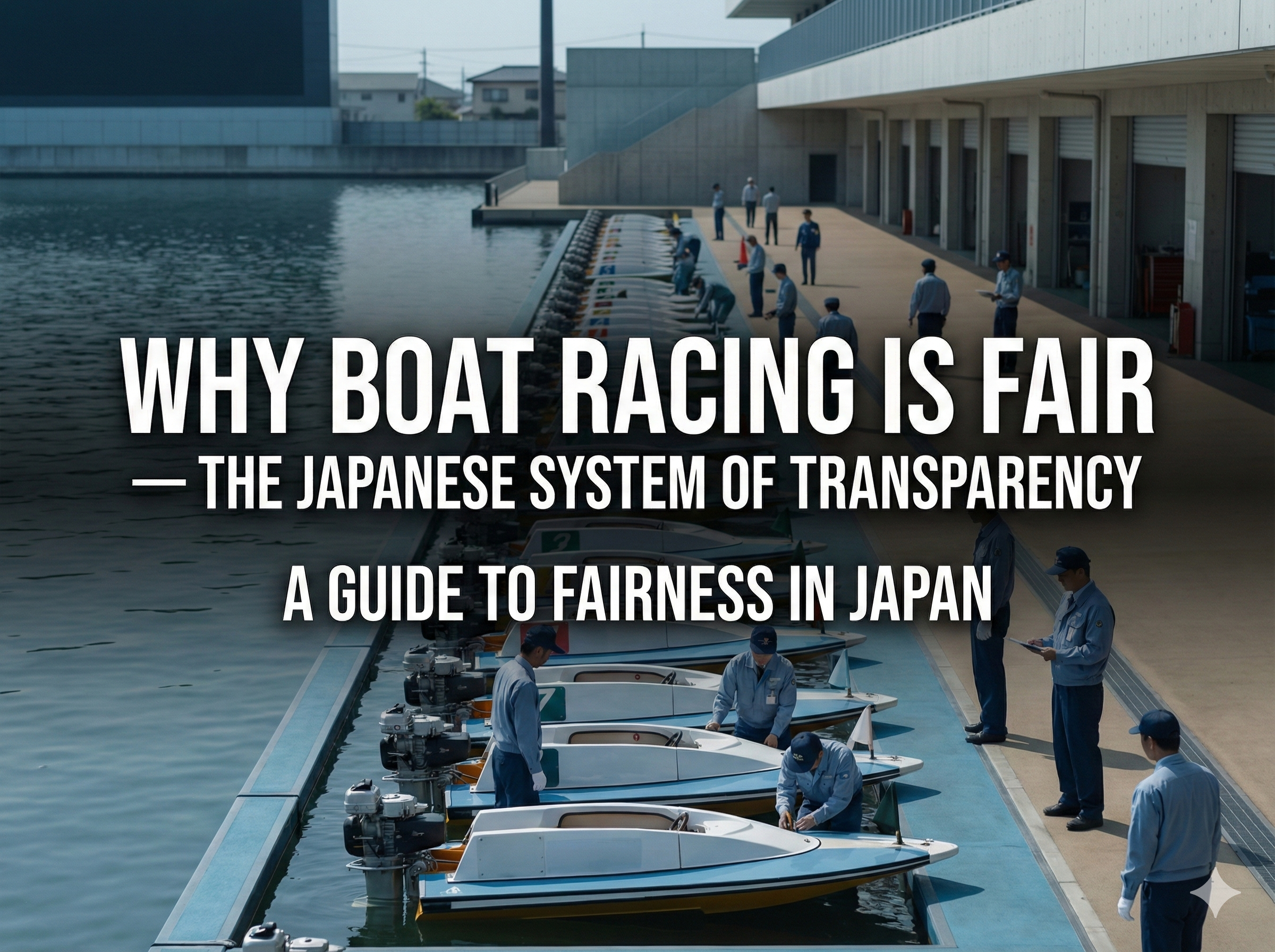
Japan's boat racing is a system designed with "fairness" and "transparency" as top priorities as a public racing sport, unlike any other in the world. From the motor lottery system to strict inspection systems and thorough information disclosure, every mechanism functions to achieve "fair competition." In this article, we explain in an easy-to-understand way for travelers why Japan's boat racing is said to be "fair" and how the system works.
1
Why Fairness Matters in Public Racing
Japan's boat racing is not just a sports event. It is a "public undertaking" based on the Motorboat Racing Act, a special law, where local governments host the races and designated national organizations conduct them. This legal status is why boat racing requires a level of fairness and transparency that cannot be compared to other professional sports.
The revenue from boat racing becomes a financial resource for the hosting local governments and is also returned to shipbuilding-related businesses and social welfare projects through the Nippon Foundation. In other words, the fairness of the races is not just about ensuring fairness in gambling, but is an essential condition for achieving the ultimate goal of contributing to "public welfare." If trust is damaged by fraud or suspicion, the entire system of public benefit return would collapse.
For this reason, the operational structure of boat racing thoroughly implements "separation of powers." The supervision by the Ministry of Land, Infrastructure, Transport and Tourism, hosting by local governments, and implementation by the Japan Motorboat Racing Association are completely separated, and a mechanism of mutual monitoring functions. In particular, all judges and inspectors are employees of the racing association and do not belong to the command structure of the host. This "separation of entertainment and judging" is the essence of institutional fairness.
Furthermore, extremely severe penalties are prescribed for bribery and match-fixing related to races: up to 5 years imprisonment or fines of up to 5 million yen. This is a harsh sentence even compared to ordinary criminal offenses and serves as a strong deterrent for racers and related parties.
2
Engine Lottery System
The symbolic ceremony of "fairness" in boat racing is the lottery of motors and boats conducted on the pre-inspection day (the day before the race). This system embodies the philosophy of "one-make" that completely eliminates advantages and disadvantages based on equipment.
Currently, all motors used in Japan's boat racing are unified to the "Yamato 331" manufactured by Yamato Motor Co., Ltd. The specifications—water-cooled vertical inline 2-cylinder 2-stroke gasoline engine, displacement of 396.9cc, maximum output of approximately 23.5kW (31PS)—are completely common across all 24 boat racing venues nationwide. Every aspect, from the material, dimensions, and tolerances of each part, is strictly managed, and theoretically, all motors should have the same performance.
However, as industrial products, micron-level individual differences and differences in "engine power (feeling)" that occur during the break-in process are unavoidable. How to fairly distribute these unavoidable individual differences is the role of the lottery system.
Motors and boats are not the personal property of racers but are owned by each racing venue. Racers "borrow" them during the race period to compete. The lottery is conducted using the classic but most tamper-proof "garapon (rotary lottery machine)" or strictly programmed electronic lottery, with racer representatives and racing association officials in attendance to monitor and prevent intentional distribution.
This system ensures that whether you are a top racer (A1 class) or a rookie B2 class racer, everyone has an equal chance of drawing an "ace motor (high win rate machine)" and also bears the risk of drawing a "worst motor (low win rate machine)." This "equality of luck" is a unique concept of fairness in boat racing that sets it apart from other motorsports where well-funded teams monopolize good equipment.
Comment
The lottery system is completely random. Popular racers have no advantage whatsoever. When watching the races, be sure to check the official website to see which racer drew which motor, as the lottery results can significantly change the day's race development.
3
Standardized Boats and Equipment
In boat racing, not only motors but also boats and equipment are completely standardized. In motorsports like F1 and MotoGP, machine performance differences are decisive factors in victory or defeat, but in boat racing, machine performance differences are considered "noise that should be eliminated." Here, the philosophy of "one-make (single specification)" is thoroughly implemented, and the principle that victory should be determined purely by racer skill (piloting technique and maintenance ability) is maintained.
The allocated motors are maintained and adjusted under the racer's responsibility. However, strict rules also exist here. Racers can perform tasks such as replacing piston rings, adjusting carburetors, and hammering out propellers (shape modification). These are considered part of the "racer's ability." On the other hand, cylinder polishing or modifications that change the basic structure of the engine are strictly prohibited. Violations result in immediate disqualification and long-term suspension.
What is interesting is the "intermediate maintenance" system implemented when motor performance differences become significantly large. This system raises "low-performance machines" that have significantly degraded due to capsizing accidents or aging to standard levels by the venue's specialized maintenance technicians on non-race days. For example, in 2023, Motor No. 29 at Miyajima Boat Race venue had its win rate drop to 19% due to two consecutive capsizing accidents, but after large-scale maintenance by technicians involving crankshaft replacement, the racer who used it in the next section won, and the win rate jumped to 29%.
This system demonstrates not just leaving things to chance, but the system actively intervening to maintain and repair "equipment fairness." By reviving dead motors, it minimizes the disadvantage for the next racer who draws that motor.
4
Official Inspections
Even if mechanical fairness is guaranteed, races cannot be conducted if the humans operating them have fraudulent intentions. Boat racing eliminates the risk of match-fixing and information leaks by physically isolating racers and conducting thorough inspections.
During the race period, racers are isolated in dormitories within the racing venue until they reach a state called "management release." During this period, commonly called "canning," racers live completely cut off from modern society. When entering the racing venue (on the pre-inspection day), racers must deposit all devices capable of external communication, such as smartphones, mobile phones, and tablets, with the racing association. In principle, they cannot leave the premises until the race period ends or they are sent home early, and contact with family is also cut off except in emergencies.
Before participating in races, multiple checkpoints are set up. In the pre-inspection, identity verification using registration tickets and inspection of prohibited items (communication devices, alcohol, cash, etc.) are conducted. Medical checks including vision, blood pressure, and body temperature are performed, and if there is any alcohol reaction, the racer is immediately disqualified. Additionally, interviews and visual inspections confirm whether the racer is mentally fit to compete.
On race day, inspections are conducted again immediately before the race. There is a minimum weight requirement of 52kg for men and 47kg for women, and if lighter, weight adjustment weights (vests or mats) must be worn. This is a handicap rule to prevent lighter racers from gaining too much physical advantage. Furthermore, it is confirmed that helmets, life jackets, and protective suits (Kevlar-made) are properly worn as specified.
Comment
The "canning" system is a harsh environment for racers, but for spectators, it provides assurance that "races are conducted fairly." Racers compete completely isolated from external influences, making the risk of match-fixing and fraud extremely low.
5
Penalties and Rules
Fairness is maintained through strict penalties for violations and clear rewards for compliance. Boat racing's punishment system is extremely strict and shows no mercy.
In particular, "same-day return home" and "immediate return home" cause severe damage to racers both economically and career-wise. Same-day return home is a penalty where the racer is released from management after the day's races end and ordered to return home, with main reasons including pre-inspection failure, second flying/start delay in the same section, two disqualifications in the same section, and maintenance defects. Immediate return home is a penalty where participation eligibility is immediately revoked and the racer is forcibly sent home even if there are scheduled races.
"Late arrival" (arriving late to the assembly time on the pre-inspection day) is severely punished as unprofessional conduct. Unless there is a legitimate reason such as transportation delays, not only does it result in same-day return home, but heavy penalties are also imposed, including several months of suspension and one year of exclusion from SG and G1 races.
Penalties for flying have been further strengthened in recent years. The first flying results in 30 days of suspension, and the second adds another 60 days (90 days total), meaning losing half of the racing opportunities in six months and effectively guaranteeing demotion to B2 class. Flying in an SG championship race results in one year of SG exclusion.
On the other hand, fair play is praised. There are systems such as the "400 races without accidents award" and "Golden Racer Award" that honor racers who have competed without accidents over long periods. These demonstrate to racers that clean racing leads to long-term career success.
Comment
When flying or start delays occur, all betting tickets related to that boat are refunded under the applicable invalidation/refund rules. If the start is judged unfair, the system prioritizes integrity over collecting money from fans—this is one of the strongest signals of institutional fairness.
6
What This Means for Visitors
Boat racing achieves a level of transparency in "information symmetry," a prerequisite for fair gambling, that is unmatched in the world. The fact that the house (host) and customers (bettors) have equal information is the greatest source of reassurance for visiting travelers.
Immediately before the actual race, all boats are required to perform a "demonstration run" on the course. In the start demonstration, the course from pit out to start and the acceleration feeling (starting speed) are shown. In the lap demonstration, boats turn around the first and second marks, allowing confirmation of boat stability during turns (cornering) and straight-line speed (straight speed). The time for the straight section is measured and announced.
Racers are obligated to give their full effort even in demonstration runs. Actions such as intentionally performing poorly to manipulate odds are subject to punishment as "violation of full effort obligation."
Boat racing venues and official websites provide extensive data: motor and boat history, parts replacement information, weather conditions (wind direction/speed, wave height), tilt angle, and more—equally available to all fans.
Furthermore, to reduce inconsistency in judgments, experienced chief judges are dispatched for top-tier events so the standard is as consistent as possible across venues.
Through these mechanisms, Japan's boat racing achieves "institutionalized trust"—a system designed to reduce human and equipment-driven distortions and protect fair competition.
7
Frequently Asked Questions
Yes. The lottery is conducted using garapon (rotary lottery machines) or strictly programmed electronic lottery, with racer representatives and racing association officials in attendance to monitor and prevent intentional distribution. Both top racers and rookies have equal chances of drawing an ace motor.
It is extremely low. During the race period, racers are placed in an isolation state called "canning," with external communication cut off. Severe penalties apply to fraudulent acts such as match-fixing, including long suspensions and possible criminal prosecution.
When flying or start delays occur, all betting tickets related to that boat are refunded under the standard invalidation/refund rules applied to that situation, which helps protect fairness for bettors.
Yes. The demonstration run lets you check each boat’s course, start acceleration, turn stability, and straight-line speed. Straight-section timing is also measured and announced, which is useful before buying tickets.
For top-tier events, experienced chief judges are dispatched to help keep judgment standards consistent across venues, reducing venue-by-venue variability.